What Is Intelligent Routing? (and why does It matter in retail?)
Intelligent routing is the ability to take a customer’s request for help and automatically send it to the best available associate, based on where they are, what they need, who’s qualified, and who’s closest, instead of paging the entire store and hoping for the best.
We didn’t come up with this idea in a boardroom. We came up with it standing on a sales floor, watching a customer walk away from a locked display case because nobody heard the call button. Or because three people heard it and none of them had the key.
If you’ve ever worked retail, you know the feeling. The overhead page that everyone ignores. The radio call that gets lost in the noise. The customer who was ready to buy, but couldn’t find a single person to help, so they left.
That’s the problem we set out to fix when we built Meerby.
The Real Problem With How Stores Handle Help Requests Today
Let’s be honest about what most stores are still working with. A handful of call buttons that customers walk right past. Overhead pages that interrupt twenty people to reach one. And once that alert goes out? Silence. No one knows if someone responded. No one knows if the customer is still standing there. No one knows if they gave up, walked out, and ordered it on Amazon from the parking lot.
There’s no queue. No priority. No context. Just noise, and a lot of hope.
And it gets worse when you zoom out. Stores are running leaner than ever. Specialized departments (think lumber, appliances, tool storage) often have limited coverage. When a customer hits a call button in one of those areas, the associate who’s supposed to help might be across the building assisting someone else. The system has no way to know that, so it just… pages again. Or doesn’t.
Meanwhile, store managers have almost zero visibility into any of this. They can’t see how many requests came in, how long customers waited, which ones were missed entirely, or where the pressure is actually building. They’re making staffing and service decisions based on gut feel, or the sales that made it to cash, not data based on the customers that didn’t.
We know this pain because we’ve lived it.
Meerby’s co-founders, Allan and Elizabeth Malcomson, have spent their careers on retail floors. They’ve run a large big-box store, survived every holiday rush, and dealt with every version of this problem. When they went looking for a call button partner who actually understood their retail operations, they couldn’t find one. So they built one.
So What Does Intelligent Routing Actually Do Differently?
Here’s the simplest way to think about it. Traditional systems broadcast. Meerby routes.
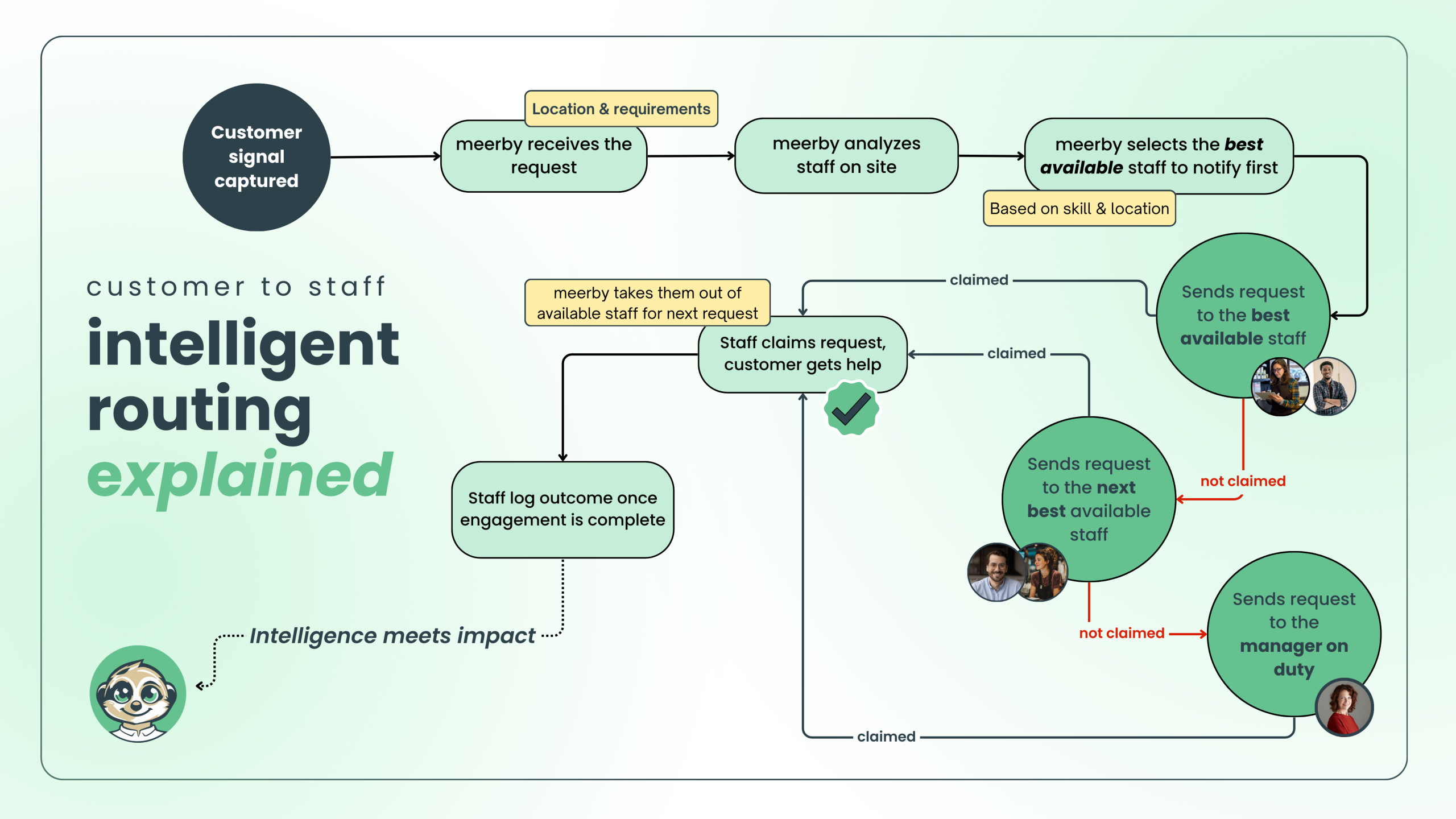
When a customer needs help, whether they press a physical call button, tap a touchscreen, or simply linger long enough for a dwell-time sensor to pick up on it, Meerby doesn’t fire off a generic alert. It makes a decision.
It knows where the request is coming from. It knows what kind of help is likely needed based on the department or zone. It checks which associates are qualified, available, and nearby. Then it sends the request directly to the best fit, with context, so that associate knows what they’re walking into before they get there.
If that person is already busy? The request escalates automatically to the next qualified team member. No radio call. No second page. No customer left wondering if anyone’s coming. Meerby’s job is to close the loop, and it doesn’t stop escalating until it’s done that.
And here’s the part that matters most to the people actually running stores: every single interaction is tracked. Response time. Engagement length. Outcome. Whether the request was resolved on the first try or needed escalation. That data flows into real-time dashboards and weekly reports that give managers something they’ve almost never had: a clear, measurable picture of in-store service performance.
Take a look at how our tech flows behind the scenes:
Why This Matters More Than Ever
The economics of retail have shifted. Discretionary spending is tighter. Foot traffic is harder to earn. And when a customer does walk into your store, the margin for error is razor-thin.
Think about your foot traffic for a second. What if half the people walking through your doors are leaving without buying, not because they didn’t find what they wanted, but because they couldn’t find help when they needed it? Even converting 1% more of those walkaways is meaningful top-line revenue. And it doesn’t require more traffic, more promotions, or more headcount. It just requires getting the right person to the right customer at the right moment.
And on the other side, associate burnout is real. Turnover costs retailers nearly $10,000 per frontline employee. Burnout doesn’t come from being busy, it comes from being unsupported, from juggling competing priorities with no system to help, from hearing an overhead page and not knowing if it’s your problem or someone else’s.
Intelligent routing addresses both sides at once. Customers get faster, more consistent help. Associates get clarity instead of chaos, and they get to focus even more on the things they feel like an expert in. Plus, stores get the data they need to actually improve, not just react.
It’s a win-win.
“Isn’t This Just Monitoring Employees?”
We hear this question, and we get why people ask it. But the answer is no, and the distinction matters.
Meerby isn’t a surveillance tool. It’s a coordination tool. Think of it like this: in a well-run restaurant kitchen, there’s an expediter who makes sure the right plate goes to the right table at the right time. Nobody thinks of that as monitoring, it’s more like coordination. That’s what intelligent routing does for a retail floor. If you’re a fan of The Bear you know the episode in Season 1 where cousin steps up? Yea. That’s Meerby.
It’s not surveillance, it’s total orchestration. And your team will thank you.
Our store partners consistently tell us the same thing: associates don’t resist Meerby. They embrace it. Because for the first time, they have a system that actually helps them do their jobs instead of just adding noise. Adoption has been, in the words of one GM, “literally immediate.”
What Does This Look Like for Large-Format Retailers?
Everything we’ve described gets amplified in big-box environments. Larger footprints. More specialized departments. Outdoor and indoor zones with completely different needs. Equipment areas where safety and compliance add another layer of complexity.
In these environments, broadcast-based systems aren’t just inefficient, they’re almost useless. An overhead page in a 100,000-square-foot store with garden center, lumber yard, and indoor showrooms? Good luck.
Meerby was designed to scale across these realities. The platform handles multiple input methods from physical buttons in high-risk equipment zones where you need them, touchscreens in departments where digital makes sense, and dwell-detection in areas where customers don’t even know they need to ask for help yet. All of it flows through one unified workflow, so associates and managers see a single, coherent picture regardless of how the request originated.
And because we’ve built this for real retail environments, not controlled test labs, we understand the non-negotiables. High reliability in high-traffic conditions. Low maintenance burden on store teams. Clear differentiation between indoor and outdoor scenarios. Scalability across different store formats and sizes without requiring a custom build for each location.
Where Intelligent Routing Is Headed
We think intelligent routing is just the starting point. The real opportunity is a unified system where customer assistance, associate tasking, and operational insight all live in one place.
Imagine a store where a customer doesn’t have to find a call button, the store already knows they need help. Where an associate’s task list is dynamically reprioritized based on real-time demand, not a static morning checklist. Where a store manager can see, in real time, exactly where service pressure is building and make staffing adjustments before problems become complaints.
That future isn’t five years away. The building blocks exist today. Meerby is already connecting physical buttons, touchscreens, and dwell-time signals into a single routing engine.
Why We Built This
We built Meerby because we believe the in-store experience can be better. Retailers have invested heavily in e-commerce, supply chain, and digital marketing. But the moment a customer walks through the door and needs help? Most stores are still relying on tools from the 1990s, or worse.
People are a store’s greatest asset and biggest differentiator. Meerby exists to make sure their effort lands where it matters: at the right place, at the right time, with the right context. Not because we read that in a strategy doc, but because we’ve spent our careers watching it make the difference between a sale and a walkout.
If that resonates, we’d love to show you how it works.
Meerby is a real-time retail platform that transforms how stores connect customers with help. Built by retailers, proven on real floors. Book a demo today and learn more.